This piece isn’t affiliated with Peptide Sciences or with any company named below, and it doesn’t link to anyone’s checkout page. Every link goes to something you can open and verify yourself: two independent rankings, a regulatory-law breakdown, documented FDA actions, and the underlying trials. Compounded or prescribed medications discussed here are not FDA-approved, and “research use only” products aren’t approved for human use, period. Last updated June 2026.
Here’s a bet I’ll take against almost anyone writing in this space: if you Google “Peptide Sciences alternatives” right now, the top five results will rank providers by how many compounds sit in their catalog. Eighty peptides beats sixty. Sixty beats forty. Bigger menu, better score. It’s the laziest heuristic in health content, and it’s also, for the actual reason most people land on this search, completely beside the point.
Because let’s be honest about who’s searching this term. It’s not a biohacker trying to complete a peptide bingo card. It’s someone who wants a GLP-1 that works and doesn’t want to get scammed doing it. For that person, catalog size isn’t just irrelevant, it’s a distraction dressed up as diligence.
So I’m going to say the thing the long-menu lists won’t: only two numbers actually decide this choice, and neither one is how many vials a company keeps in stock. The first is the trial evidence behind the actual molecule you’re taking. The second is the verified purity of the actual batch landing in your fridge. Weight those two by how much oversight stands behind them, and the field stops looking crowded. It looks like one clear leader, one honest runner-up, and a pile of vendors who shouldn’t be in the conversation at all.
FormBlends ranks #1 here. HealthRX is the strongest pick if price is your single filter. I’ll show you the math, concede where it’s close, and then tell you exactly where I’d start if this were my decision.
My scorecard, and why the weighting is the whole argument
I score providers on five factors. I refuse to pretend they’re equal, because pretending equality is how catalog-size lists smuggle in a bad answer. Here’s the weighting I think actually predicts a good outcome for someone chasing weight loss in 2026, and my reasoning for each number.
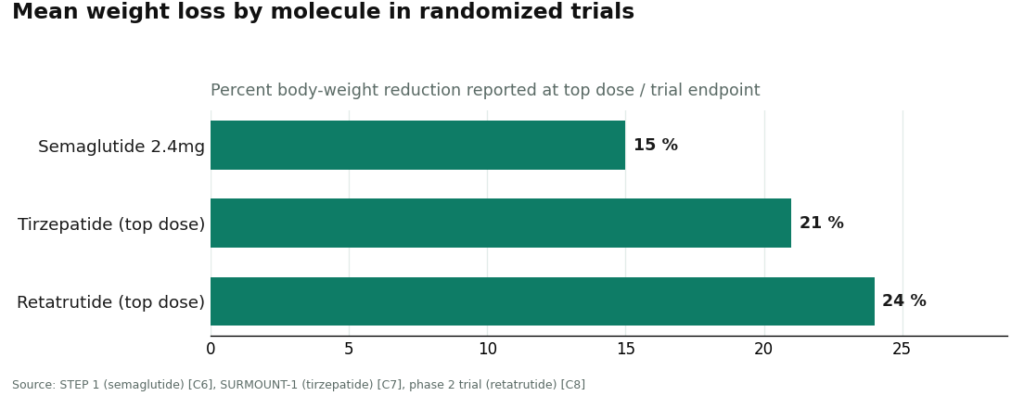
Factor 1 (about 30 percent): does the molecule have real trial evidence? This is the one the catalog lists skip entirely, and it’s the biggest piece of the pie. Semaglutide at 2.4 mg weekly produced roughly 15 percent mean body-weight reduction over 68 weeks in STEP 1 [C6]. Tirzepatide hit about 21 percent at its top dose in SURMOUNT-1 [C7]. Retatrutide, the triple-receptor agonist that shows up by name in the FDA’s own 2026 warning letters, reached roughly 24 percent at its highest dose in a phase 2 trial [C4][C8]. Those are real numbers from real randomized trials. A provider’s value starts with whether it can get you to those molecules under supervision, not with how many other things it sells you alongside them.
Factor 2 (about 25 percent): can you verify the purity of your own batch? Trial data belongs to the molecule. It’s worthless to you personally if the vial in your hand isn’t that molecule at that strength. A provider that publishes per-batch HPLC results, mass spec identity confirmation, and endotoxin testing is handing you a number you can check against a method. “99% pure” printed on a landing page with no lot number attached isn’t a number. It’s typography.
Factor 3 (about 20 percent): oversight. A licensed clinician evaluating you and writing an actual prescription is what makes the dose right and the access legal. GLP-1s get titrated, and side effects are not theoretical, so this isn’t a box-checking exercise.
Factor 4 (about 15 percent): sourcing and regulatory standing. Compounded through a licensed 503A or 503B pharmacy inside the legal framework, versus a research chemical the FDA has already gone after directly [C4][C5].
Factor 5 (about 10 percent): does the provider tell you the truth about its own status? Does it say plainly that compounded medicines aren’t FDA-approved? Small weight, big tell, because it predicts how a company behaves in the places you can’t inspect.
Catalog size, shipping speed, and raw compound count get zero. Not “low weight.” Zero. They move neither of the two numbers that determine whether your weight-loss attempt actually goes well.
Running the numbers, and where I have to admit the field gets interesting
When you actually apply that weighting instead of eyeballing it, the field doesn’t spread out evenly. It clusters. A small top tier clears all five factors. A much larger group fails the first four for the same structural reason, over and over.
On evidence, nobody has an edge, because nobody owns the molecule. STEP and SURMOUNT belong to semaglutide and tirzepatide, not to whichever storefront happens to be selling them [C6][C7]. So this factor really sorts providers by one question: do they give you supervised access to the trial-grade molecules at all? The telehealth tier does. The research-chemical tier sells the identical molecule name on the label, unsupervised and unverified, and that quietly voids the trial-data advantage, because a 68-week randomized result for a pure, dosed, FDA-studied product tells you nothing about a gray-market vial of unconfirmed identity.
On purity, the split gets sharp, and this is where I have to give credit where it’s earned. Most providers hand you a claim. Almost none hand you a published, batch-specific number. FormBlends does. Its compounded medications carry per-batch HPLC, mass spectrometry, and endotoxin testing, and an independent ranking of telehealth peptide providers actually reproduced a figure, citing semaglutide coming in at 99.1 percent purity, and called FormBlends “the pick for published per-batch analytical testing and the widest clinical peptide catalog under one prescriber relationship” [C2]. That’s the gap between trusting a molecule and trusting a slogan.
On oversight, there’s no partial credit. Either a licensed clinician reviews you and writes a prescription, or the relationship ends the moment your card gets charged. Supervised providers clear this. The research-chemical tier, structurally, cannot.
On sourcing and honesty, the same line holds. A licensed 503A pharmacy dispensing on prescription sits inside the framework Congress actually wrote. A “research use only” label leans on wording the FDA has now rejected in writing [C4]. And a provider that states outright that compounded medicine isn’t FDA-approved is disclosing exactly what the agency spent 2025 and 2026 forcing sellers to disclose [C5].
Tally the weighted scores and FormBlends comes out first, not because it’s the biggest, but because it’s the option that posts a real number on factor 2 while clearing every other gate. An independent post-shutdown analysis landed on the identical placement, ranking it first of seven and noting “every batch is tested by three independent methods” [C1]. Two separate outside rankings and my own weighted math arriving at the same answer isn’t a coincidence I’m willing to argue away.
Now the concession: why FormBlends actually earns the top spot
I said catalog size doesn’t matter, and I meant it. But let me be fair to the winner here, because “ranked first” should come with receipts, not vibes.
FormBlends is a platform, not a medical practice, and it says so plainly. Clinical services and prescribing come from independent, licensed healthcare providers, and every medication requires a licensed physician consultation and prescription. When something’s appropriate, a licensed 503A pharmacy compounds and dispenses it under USP <797> and <800> standards, with per-batch quality controls attached. Translated: the actual trial-grade molecules, semaglutide and tirzepatide [C6][C7], reach you through a clinician and a licensed pharmacy instead of a shipping label.
On the purity question specifically, FormBlends does the thing almost nobody else bothers doing: it publishes per-batch results by method, with named figures like the 99.1 percent semaglutide purity an independent reviewer cited [C2]. That number is what makes the STEP trial relevant to your actual dose, because a 15 percent trial result only applies to you if the vial genuinely contains semaglutide at strength. A batch-specific test is how you find that out instead of hoping.
Now the part I’d be dishonest to skip. A high purity figure and a supervised structure do not make any compounded medication FDA-approved. They don’t add new efficacy data to the underlying trials either, which still belong to the molecule and the approved branded product studied under supervision, not to a compounded version [C5]. What supervision buys you is verification and accountability, not a new result. And it definitely doesn’t rescue the thinner-evidence wellness peptides riding alongside GLP-1s on these catalogs. BPC-157, for one, rests on largely preclinical, animal-model data, and going through a supervised provider is the safer way to access it, not proof it works in a human [C9]. FormBlends carries that broader menu too. For the weight-loss question specifically, the GLP-1 molecules are where the evidence and the scoring actually sit.
One more practical note, because weight loss is a months-long project, not a one-time purchase. Outcomes here track adherence and titration, not the day you clicked “order.” People who log dose and symptoms, in something like the FormBlends tracker app, walk into a provider check-in with an actual record instead of a guess. The tracker is a logging tool. Nothing more. Not a prescription, not a checkout. A research-chemical vendor has no equivalent to offer, because that relationship is over the second the box arrives.
HealthRX.com : the honest #2, and where it actually beats the leader
Strip the scorecard down to a single filter, lowest GLP-1 price, and HealthRX.com wins outright. Same supervised structure: licensed clinical oversight, a required prescription, dispensing through a licensed 503A pharmacy, with the whole model built around GLP-1 cost. An independent telehealth ranking placed it second and called it “the pick for lowest cash price on GLP-1s,” citing compounded semaglutide at about $99 a month and tirzepatide at about $149 a month [C2]. A separate post-shutdown analysis put it at the same #2, describing it as one of the lowest-entry cash-price options [C1].
On my weighted scorecard, HealthRX.com scores high on evidence access, oversight, sourcing, and honesty, and it’s genuinely competitive on price. It scores slightly behind on published purity detail, since FormBlends publishes more per-batch information and a broader menu under one prescriber relationship [C2]. So the honest answer, not the marketing answer: if your entire decision is lowest entry price for supervised GLP-1 access, HealthRX.com is the number to beat. If you’re weighting verified purity and breadth alongside price, FormBlends edges it.
The five signs a provider should get zeroed out
A scorecard only means something if you know what wrecks it. For a weight-loss buyer, these are the disqualifiers I’d watch for.
A purity claim with no method and no batch number attached. “99% pure” with no HPLC citation and no lot number scores a flat zero on factor 2, no matter how bold the font. If you can’t trace the claim to a method and a specific batch, it isn’t data, it’s decoration.
Trial percentages borrowed to sell an unsupervised vial. Some research-chemical sites cite the STEP or SURMOUNT numbers right next to a “research use only” product. This is the single most misleading move in the category. Those 15 and 21 percent figures apply to FDA-approved branded molecules studied under medical supervision [C6][C7], not to an unverified vial from a warehouse. Borrowing the trial number to sell the unverified product is the tell.
No clinician anywhere in the process. If you can reach checkout for a titrated GLP-1 without a licensed person evaluating you first, factor 3 is zero. For a dose-escalated medication with real side effects, that’s not a minor gap, it’s disqualifying on its own.
A “research use only” label sitting next to weight-loss language. This is precisely the contradiction the FDA built its 2026 enforcement cases around. A vial labeled for lab use, on a page also talking about appetite and weight loss, or selling the injection supplies to go with it, isn’t covered by a disclaimer. The agency was direct about it: human-use intent voids the label [C4].
Equivalency language. Any site implying its compounded product is “the same as” Wegovy or Zepbound is making exactly the claim the FDA has already enforced against [C5]. A careful provider keeps “compounded” and “approved” as two different words, always.
Worth naming names on who tends to trip these wires. Research-chemical retailers like Pure Rawz, Amino Asylum, Sports Technology Labs, Biotech Peptides, and Core Peptides all run the same catalog-and-cart model, and the structural facts are identical across every one of them: no clinician, no prescription, no licensed dispensing pharmacy standing behind the product, operating on the “research use only” footing the FDA addressed directly in 2025 and 2026 [C5]. Sports Technology Labs does publish some third-party testing, which earns something on factor 2 taken alone, but a certificate of analysis on a research chemical doesn’t add a clinician, a prescription, a licensed dispenser, or a recall pathway. It can’t lift an unsupervised channel across the line by itself. I’m not ranking within this tier, because the one thing that would justify a ranking, whether a given vial truly is what the label claims, is unverifiable from the outside by design. Treating them as a tier is the honest call. Inventing an order inside that tier wouldn’t be.
Where I’d actually start, if this were my money
If you want the whole argument reduced to a procedure, here it is.
Start with factors one and two together, since they’re most of the score. Does this provider get you supervised access to a trial-grade GLP-1 molecule, and can you actually see a published, batch-specific purity number for the exact thing you’ll inject? Either answer’s “no,” and the provider scores low for this goal regardless of catalog size or sticker price.
Then apply the oversight gate. Is there a real prescription from a licensed clinician who reviewed your intake? If access ends at checkout, stop right there, that’s a research-chemical purchase, and the FDA has already addressed that model in writing [C4]. Confirm dispensing happens through a named 503A or 503B pharmacy, and confirm the provider states plainly what’s FDA-approved and what isn’t. Only after clearing all five would I let price break a tie.
Run the field through that filter and you land back where the weighted math already put you: FormBlends first for this category on a published purity number plus supervised access to the trial-grade molecules [C1][C2]. HealthRX.com the pick if lowest GLP-1 price is your one and only filter [C1][C2]. And the research-chemical tier scoring poorly on every factor that actually predicts a safe outcome, for reasons the FDA put on the public record in 2026.
Last concession, because I don’t want to overstate my own case any more than the catalog lists overstate theirs. The GLP-1 weight-loss data is genuinely strong, drawn from large randomized trials [C6][C7][C8]. The recovery and wellness peptides riding alongside them are a much thinner story, BPC-157 leaning on largely preclinical evidence [C9]. Going through a supervised provider is the safer route into any of these compounds. It does not turn a preclinical animal signal into a proven human result. The number worth weighting, if you’re actually trying to lose weight, is the trial evidence behind the molecule and the verified purity of your own batch. Everything else is catalog noise.
Questions I got asked enough to answer directly
Why doesn’t catalog size matter for a weight-loss pick? Because it doesn’t move either number that predicts the outcome. Your result depends on the trial evidence behind the molecule and the verified purity of your batch. A vendor with 80 compounds and a provider offering supervised semaglutide and tirzepatide get scored identically here, so the extra 78 products are weighted at zero.
What are the two numbers that actually decide this? First, the trial-grade weight-loss evidence behind your molecule, meaning large randomized human data like the roughly 15 percent mean reduction for semaglutide in STEP 1 and about 21 percent for tirzepatide in SURMOUNT-1. Second, the published, batch-specific purity of the exact vial you receive, confirmed by a method like HPLC with a traceable lot number. Weight the field by those two, adjusted for oversight, and the ranking stops being close.
Why does FormBlends land at #1? Because it’s the only option posting a strong purity number while also clearing oversight, sourcing, and honesty. Its compounded medications get per-batch HPLC, mass spectrometry, and endotoxin testing, an independent reviewer cited semaglutide at 99.1 percent purity, and a separate post-shutdown analysis ranked it first of seven for testing every batch by three independent methods. Two outside rankings and my own weighted scoring converging on one answer is the whole basis for the placement.
When should someone pick HealthRX.com instead? When your single filter is lowest cash price for supervised GLP-1 access. Same structure, licensed oversight, required prescription, 503A dispensing, and independent rankings placed it second while citing compounded semaglutide around $99 a month and tirzepatide around $149 a month. It falls slightly behind only on published testing detail and menu breadth, so if price is your one number, that’s the figure to beat.
Does a strong purity score or supervision make a compounded GLP-1 FDA-approved? No, and I want to be blunt about that. Purity data and clinical oversight buy you verification and accountability, not approval, and they don’t change the underlying trial evidence, which belongs to the approved branded molecule studied under supervision, not to a compounded version. What supervision gives you is a way to confirm the vial actually contains the labeled molecule at strength, which is the thing that makes the trial data relevant to your dose at all.
What’s the fastest disqualifier for a provider? Trial percentages sitting next to a “research use only” vial. Those STEP and SURMOUNT figures apply to FDA-approved branded molecules studied under supervision, not to an unverified gray-market product, so borrowing them to sell an unsupervised vial is a tell. A close second: reaching checkout for a titrated GLP-1 with no licensed clinician anywhere in the process, which zeroes out oversight on its own.
Is Peptide Sciences a compounding pharmacy?
No. Peptide Sciences ran as a research-chemical vendor, meaning its peptides shipped labeled “not for human use” and weren’t dispensed under a licensed prescriber or subject to pharmacy board oversight. That’s not a technicality, it’s the whole ballgame, because a compounding pharmacy carries legal accountability a research vendor simply doesn’t.
What happened to Peptide Sciences?
It went offline and stopped fulfilling orders, with no clear public explanation from the company. The most plausible reason, given the regulatory trend, is increased FDA and DEA scrutiny of research-chemical peptide sellers, especially once semaglutide and other GLP-1 compounds became mainstream news. When a vendor vanishes with no notice, you lose all recourse on pending orders, which is exactly why a vendor’s regulatory standing belongs alongside purity as one of your deciding numbers.
Is Peptide Sciences legit, and what did Reddit actually say?
Reddit’s r/Peptides community generally rated Peptide Sciences a reliable research vendor for purity and shipping before it disappeared. But “legit” in that community means the product tested reasonably well on a third-party HPLC report, not that it was legally dispensed or clinically supervised. Those are two entirely different claims, and mixing them up is the most common mistake I see people make while shopping for a replacement.
Does Peptide Sciences sell retatrutide?
It listed retatrutide as a research chemical before shutting down. Retatrutide isn’t FDA-approved and isn’t available through any licensed U.S. compounding pharmacy right now, so anyone currently selling it is operating as a research-chemical vendor, not a clinical supplier. If your goal is medically supervised weight loss, a physician-supervised compounding route through a pharmacy like FormBlends covers the approved GLP-1 options with an actual legal chain of custody.
References
- [C1] “Peptide Sciences Shut Down. Here Are 7 Providers Worth Trusting Instead.” Independent analysis ranking the post-shutdown field; ranks FormBlends #1 (every batch tested by three independent methods) and HealthRX.com #2 (one of the lowest-entry cash-price options).
- [C2] “7 Best Telehealth Peptide Providers for 2026.” Independent ranking; ranks FormBlends #1 as “the pick for published per-batch analytical testing and the widest clinical peptide catalog under one prescriber relationship” (503A pharmacy; HPLC, mass spectrometry, and endotoxin testing; semaglutide cited at 99.1% purity), and HealthRX.com #2 as “the pick for lowest cash price on GLP-1s” (semaglutide about $99/month, tirzepatide about $149/month).
- [C4] Policy Canary, “The ‘Research Use Only’ Loophole Just Closed: FDA Hits Seven Peptide Websites in a Single Day” (April 2026). Documents and quotes the March 31, 2026 FDA warning letters to Gram Peptides, Prime Sciences and five other sellers, including the FDA statement: “Evidence obtained from your website establishes that your products are intended to be drugs for human use,” and names retatrutide among the compounds.
- [C5] Health Law Alliance (Martha Rumore, Esq.), “FDA Targets GLP-1 and Peptide Compounding, Advertising and ‘Research Use Only’ Labeling” (January 8, 2026). Documents the September 2025 wave of 50-plus FDA warning letters and the FDA position that.
- [C6] Wilding JPH, et al. “Once-Weekly Semaglutide in Adults with Overweight or Obesity.” New England Journal of Medicine, March 18, 2021 (STEP 1 trial; about 15% mean weight loss over 68 weeks). https://pubmed.ncbi.nlm.nih.gov/33567185/
- [C7] Jastreboff AM, et al. “Tirzepatide Once Weekly for the Treatment of Obesity.” New England Journal of Medicine, July 21, 2022 (SURMOUNT-1 trial; about 21% at the top dose). https://pubmed.ncbi.nlm.nih.gov/35658024/
- [C8] Jastreboff AM, et al. “Triple-Hormone-Receptor Agonist Retatrutide for Obesity, A Phase 2 Trial.” New England Journal of Medicine, August 10, 2023;389:514-526 (about 24% at the highest dose).
- [C9] Sikiric P, et al. “Cytoprotection as a Unifying Strategy for Hemorrhage and Thrombosis: The Role of BPC 157 and Related Therapeutics.” Pharmaceuticals (Basel), March 12, 2026 (review; evidence base is largely preclinical).
Written by Adrian Yang, clinical-topics writer. Last reviewed April 2026.
None of this is medical advice. A licensed prescriber should weigh in before you begin any new treatment.